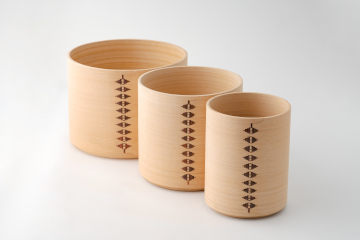
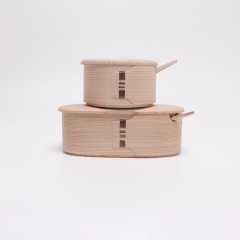
Odate Bentwood Lunch Boxes

—A beautiful technique and lifestyle inherited in the “land of wood” Japan—
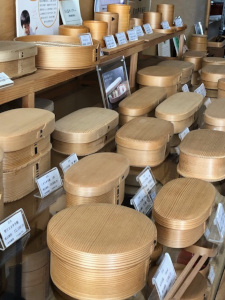
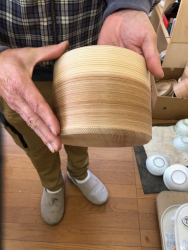
This is my fourth year of preparing lunch boxes, so I am still very much a novice in this field. My desire is to make tasty lunch boxes, and in particular to preserve the fluffiness of the rice even when it cools. Accordingly, my admiration for magewappa (bentwood lunch boxes) kept on growing day by day, and then I happened to come across the plain magewappa made by Shibata Yoshinobu Shoten in the city of Odate in Akita Prefecture. These bentwood lunch boxes are characterized by the fine grain patterns of the plain wood and their lightness. I immediately fell in love with this simple beauty. Since the grain patterns and color differ slightly, no bentwood lunch box is the same as the others. I wanted my own lunch box, the only one of its kind in the world!
So for this article I visited Odate in Akita Prefecture, the hometown of this cherished bentwood craft. From the airplane the forests of Akita Prefecture appeared like a tapestry of coniferous Japanese cedar trees and broad-leaved trees, such as wild cherry trees (yamazakura). Apparently, over many, many years, these trees have survived severe natural conditions and grown into these well-balanced and beautiful forests. Forests account for around 70% of Japan’s total land area, and the bentwood craft born from the artisans’ love of nature and their skills in creating tools from wood is a gemlike gift of the forests.
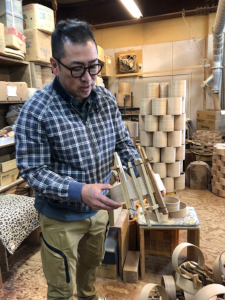
Mr. Yoshimasa Shibata, the president of Shibata Yoshinobu Shoten in Odate, kindly answered my questions.
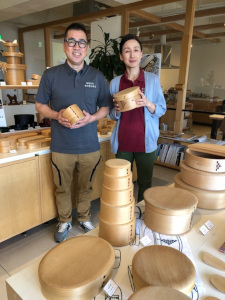
Mr. and Ms. Yoshimasa Shibata
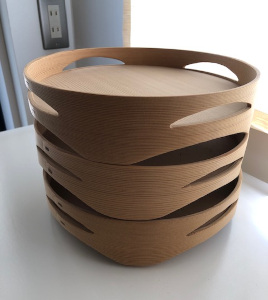
A work by Yoshimasa Shibata called BON (tray)
What are magewappa?
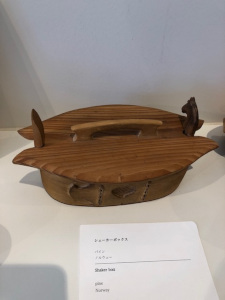
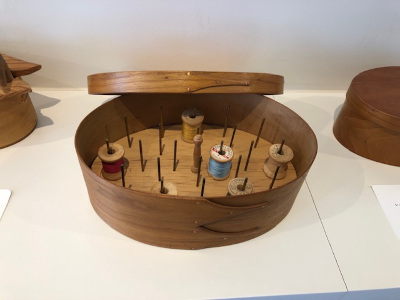
Magewappa are utensils made by shaving and bending strips of mainly coniferous wood, and especially cedar in Japan. Such utensils are called magemono. Wappa refers to the circular shape formed by bending the strips of wood. Such woodcraft exists elsewhere in Japan too and indeed around the world as well.
Norwegian wood box
A thread container used by Shaker believers in America
What distinguishes Odate magewappa, however, is that it is the only technique in Japan to have been designated as a traditional craft. Magewappa itself has a long history stretching back, it is said, to about 2,000 years ago. In the past woodcutters engaged in mountain work and fishermen out at sea used large lunch boxes known as issho wappa. They were so-called because literally the lunch boxes would contain one measuring cup (equivalent to 1.8 liters) of freshly cooked rice crammed in from bottom to lid, which would be enough for two meals. These were daily-life utensils that enabled laborers working hard from early morning to carry two meals around with them.
Based on the traditional shape, the Woodcutter’s Lunch Box of Shibata Yoshinobu Shoten is a smaller version befitting the modern lifestyle. There is space inside for other food, and attention is focused on ease of use. But the company’s founder, Yoshinobu Shibata, came up with the name Woodcutter’s Lunch Box so as to preserve the design and spirit of the past.
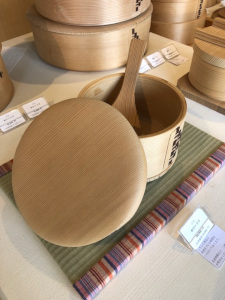
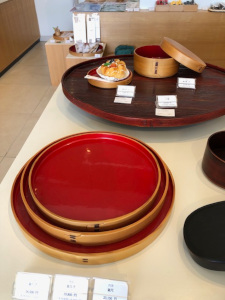
Traditionally various types of bentwood containers have been made, including trays, food steamers, and rice-serving tubs.
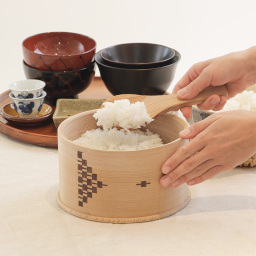
Rice-serving tub
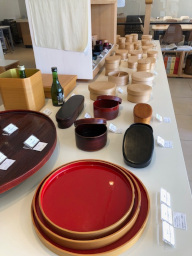
Trays
Because the magewappa of Shibata Yoshinobu Shoten are made from plain (unpainted) wood, the lunch boxes perfectly absorb the food’s excess moisture, giving them an antibacterial effect, and the gentle fragrance of the Japanese cedar brings out the tastiness of the steamed rice.
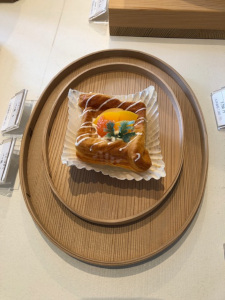
In addition, the bread plate absorbs the moisture emitted after making toast, so the warm bread has a delicious finish too.
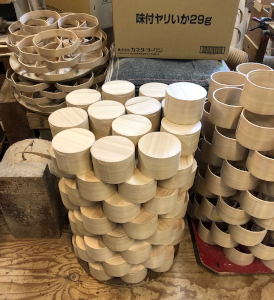
Plain-wood lunch boxes
Bread plate
The Process of Making Magewappa
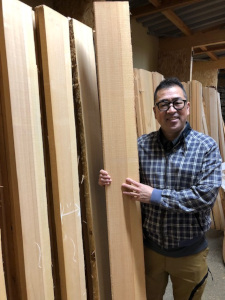
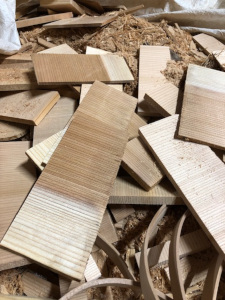
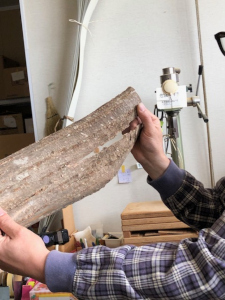
Examining the timber: Enduring heavy snowfall and growing slowly, the cedar’s growth rings narrow, making it ideal for magewappa. In 2013, however, felling was prohibited in order to preserve the natural Akita cedar. Since then the search for good cedar in other areas in the Ou Mountain Range outside Akita has become a precondition for producing bentwood craft, for which the timber is everything.
Checking of the timber
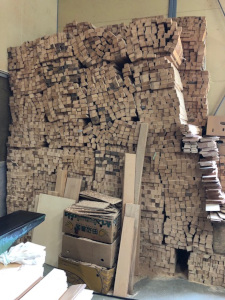
Storage of good timber
Reuse, recycle
Slicing: The timber is shaved into slices, the thickness of which depends on the size of the container. Every single natural tree has its own uniqueness, so the shaving is done with care. When the product is finished, the slices will have a thickness of 3 or 4 mm. Since the edges of the slices overlap when they are assembled, they have to be shaved finely to the same thickness as the timber.
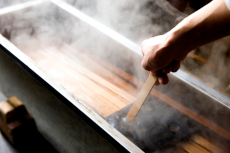
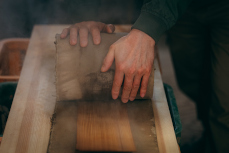
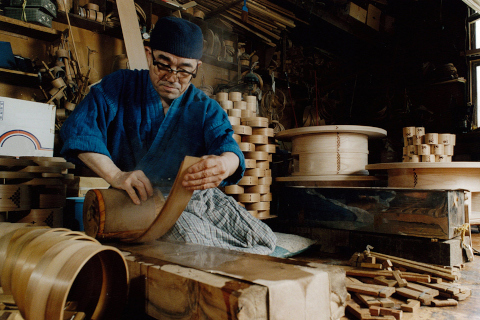
Bending: A boiling tank is filled with water, and the timber is heated overnight in water measuring 80 degrees Celsius. When the timber becomes soft, it is wrapped around a roller-like utensil called a goro.
Boiling tank
Winding the strip of wood onto the goro to bend
Fixing with a wooden clamp
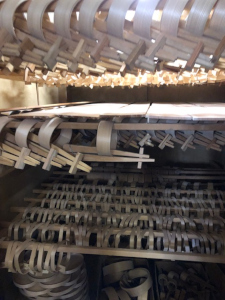
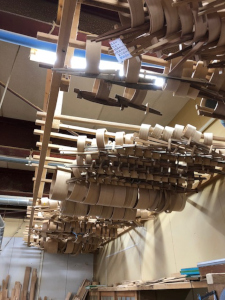
Drying: The slices of wood are fixed with wooden clamps and dried for seven to ten days until the ideal curve is formed. Since the curve cannot be corrected once it has been formed, the initial bending is most important. Sometimes, added Yoshimasa Shibata, there is wood that does not want to bend, so in such cases it is essential to listen to the mood of the wood (in other words, ascertain the nature of the wood).
Drying room
Wait for drying
Traditional all-purpose wooden clamps
Assembly: The precisely shaved bottom is installed and glued.
Installing the bottom sheet
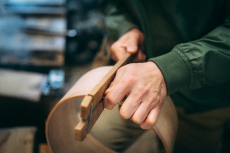
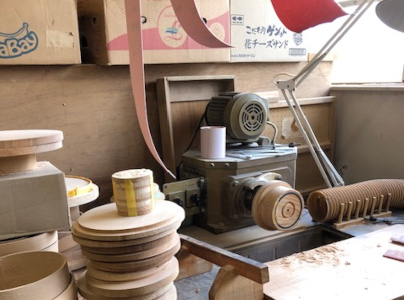
Wheel: Used to smooth the outside of round objects.
Adjustment: The product is carefully polished with sandpaper attached to the wheel.
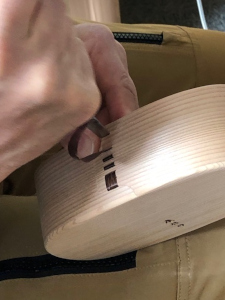
Joining the seams: The artisan finds soft tree rings and opens holes there to join the seams with wild cherry bark. This process is now primarily decorative. Giving the wild cherry bark a shiny and extremely thin finish is no easy matter. Even now Yoshimasa Shibata goes into the mountains himself to procure good-quality timber. The three types of wild cherry bark stitching patterns that also have designability go back to the ideas of Yoshinobu Shibata, who learned them from old bentwood techniques, and they have been carefully treasured ever since then.
Determining the soft tree rings and opening holes
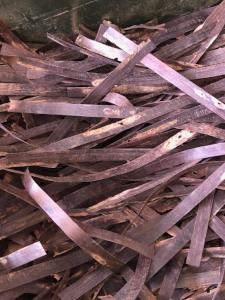
Wild cherry bark
Shaved thinly for use in joining seams
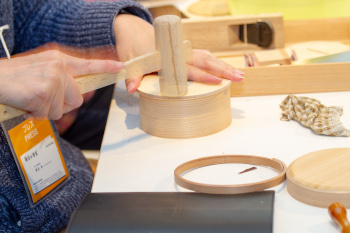
Each process is thoroughly manual, requiring skills and senses, precision and care. It is an earnest battle with the wood. The artisans engage in a single process for a certain period of time, endeavoring to polish their skills in each process and eventually become master bentwood artisans.
Shibata Yoshinobu Shoten
The current chairman of the company, Yoshinobu Shibata, switched from the forestry industry in 1964 and founded Shibata Yoshinobu Shoten in 1966 after studying the manufacture of bentwood products by himself. In 1979 he became a director of the Odate Magewappa Cooperative and busied himself with securing timber, establishing the environment, and producing reference materials. As a result of these efforts, Odate magewappa was designated as a traditional craft of Japan in 1980. Yoshinobu performs demonstrations both domestically and internationally and also plans lecture meetings and exhibitions. He engages in the collection of Japanese and foreign bentwood objects as well.
The mission and passion of Yoshinobu Shibata, a traditional craftsperson, serve as the basis enabling people today to hold beautiful bentwood craft in their hands. He is a true bentwood craft master, and the artisans who work there are proud of the company name.
Chairman Yoshinobu Shibata
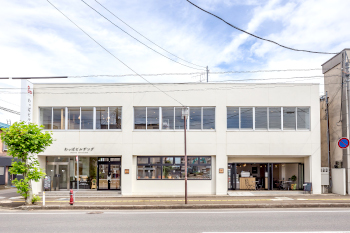
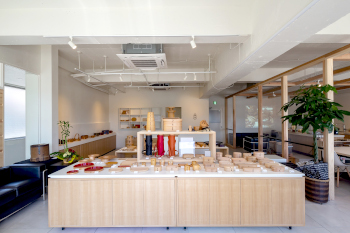
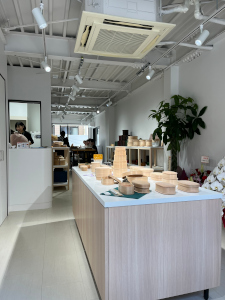
The second-generation Yoshimasa Shibata became an apprentice under his father in 1988. He has developed the Magewa series of products suited to the modern lifestyle, and in 2018 he opened the Wappa Building in Odate to provide a place where admirers of the bentwood craft could gather. He serves as president of the Odate Magewappa Cooperative.
Wappa Building
Wappa Building Store
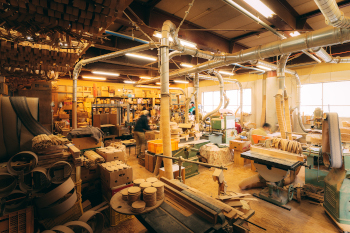
At present Shibata Yoshinobu Shoten has 14 artisans engaged in carrying on the techniques and introducing the bentwood craft both in Japan and overseas. Recently more women have been showing a desire to become artisans, so the company has been taking steps to ensure that its studio is a comfortable workplace for women. It also makes efforts to foster future traditional craftspeople by orienting instruction methods to suit present-day artisans. In addition, the company organizes production workshops to make people even more familiar with the bentwood craft. It also engages in Akita cedar tree-planting activities with children.
Inside the studio
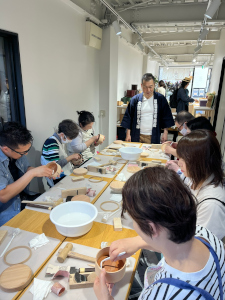
A bentwood craft production workshop
In 2024 Shibata Yoshinobu Shoten launched a new brand called Genpei. In this brand the company uses and gives a lacquer coating to the outer portion of the wood, known as the sapwood, which until then it had not been using. This was a new step forward in innovation and transmission, enabling the use of precious timber without any waste. The brand name Genpei is a portmanteau formed from the names of the two dominant families in ancient Japan, the Minamoto (Genji) and the Taira (Heike); it symbolizes the full use of the tree’s heartwood and sapwood.
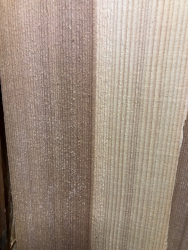
Heartwood and sapwood
(The latter has newer growth rings.)
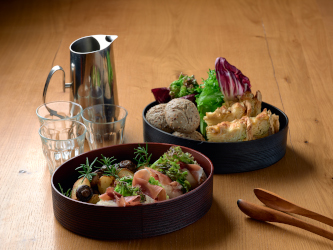
Genpei brand utensil
(mixture of sapwood and heartwood)
Genpei
Yoshimasa Shibata also frequently travels overseas to introduce the bentwood craft. In Paris the combination of cedar and wild cherry tree was unusual, and Japanese lunch boxes were made in cooperation with a local Japanese restaurant. In Milan students were amazed by the precision of the bentwood craft, which involved assembling bentwood without leaving any gaps. And in Sonoma, California, a local shipwright who visited showed much interest in the bentwood techniques and was surprised by the different usage of such tools as planes and saws.
Although these countries do not have Japan’s unique culture of packing rice together with other food in lunch boxes, there was a general recognition of the beauty of magewappa and plenty of suggestions for their use.
The Future of Magewappa
Yoshimasa Shibata is involved in numerous initiatives to safeguard the future of the bentwood craft, including the holding of workshops in the Kagurazaka store in Tokyo. Prominent ideas include a butter case (maintaining a temperature that is just right for spreading the butter) and a champagne cooler (maintaining a temperature with no surface condensation even when ice is added). Yoshimasa has received many awards both in Japan and overseas for his initiatives. His next project involves the manufacture of a magewappa for making miso. Yoshimasa Shibata is a bentwood craft ambassador, engaging in the design, research, production, and transmission of products himself as a master of the traditional craft.
Champagne cooler
Butter case
In the Wappa Building I purchased my long-cherished bentwood lunch box. The thought of actually using the real thing sent a tingle up my spine. Maintenance is a little difficult, but I was given the hint that a sushi tub using vinegar does not blacken. I was told that daily maintenance can be simply done by washing with citric acid and a scrubbing brush and completely drying. Daily maintenance sounds like fun too! Used for 10 years, the lunch box will become even more beautiful as the wood-grain pattern stands out. And if you so wish, you can coat the lunch box with lacquer for even longer use. As Yoshimasa Shibata said, he wishes to transmit and connect to the next generation. This was the start of my bentwood lunch box life.
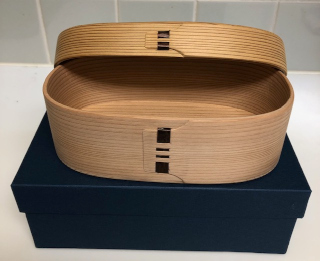
The only one of its kind in the world!
Cooperation
Shibata Yoshinobu Shoten
https://magewappa.com/ (Japanese site only)
Main store/shop/studio
2-15-28 Onari-cho, Odate City, Akita Prefecture 017-0044
Tel./fax: 0186-42-6123 Email: info@magewappa.com
Wappa Building Store
1F, 1-12-27 Onari-cho, Odate City, Akita Prefecture 017-0044
Tel.: 0186-59-7123 Fax: 0186-59-7122
Kagurazaka Store
6-26-6 Kagurazaka, Shinjuku-ku, Tokyo 162-0825
Tel.: 03-6265-0047
Nihonbashi Mitsukoshi Store
5F of Main Buildng, Creators’ Table, 1-4-1 Nihonbashi Muromachi, Chuo-ku, Tokyo 163-8001
Tel.: 03-3274-8533
Hankyu Umeda Store
8-7 Kakuda-cho, Kita-ku, Osaka City, Osaka Prefecture 530-8350
Tel.: 06-6361-1381 (switchboard number)
Iwataya Store
6F of Iwataya Store’s New Annex, Daily Life and Japanese and Western Tableware, 2-5-35 Tenjin, Chuo-ku, Fukuoka City, Fukuoka Prefecture 810-8680
Tel.: 092-721-1111 (switchboard number)
Kagurazaka Store
Workshop at Kagurazaka Store