—Infinite Arrangements— How About Displaying a Byobu Folding Screen, the Ultimate Photogenic Item?
—Infinite Arrangements— How About Displaying a Byobu Folding Screen, the Ultimate Photogenic Item?
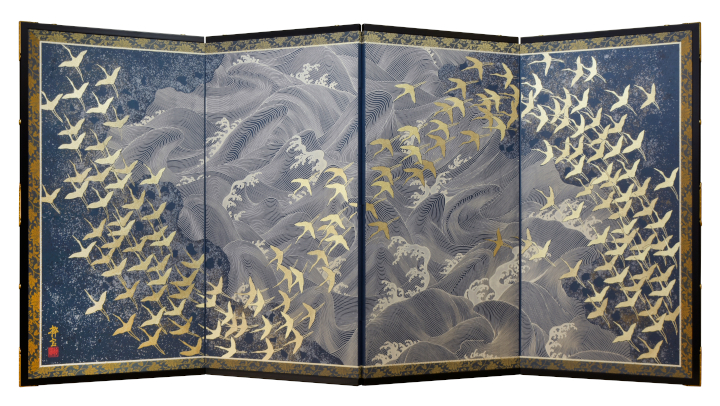
I have loved admiring large folding-screen paintings for a long time. Whenever I visit an exhibition of a certain type of byobu (folding screen) at a museum or art gallery, I have a desire to go on gazing at them forever. At a special exhibition last year, I encountered a byobu in which the picture or design changed depending on how it was folded, and so I became interested in the fascinating structure of byobu too. Wishing to learn more about byobu, I visited the Kataoka Byobu Store, the only byobu specialty store remaining in Tokyo, where I discovered that today this traditional decorative item is being arranged in a variety of ways. Byobu are not only displayed in museums; they also have much potential for being used in a wide range of ways in modern living spaces and events.
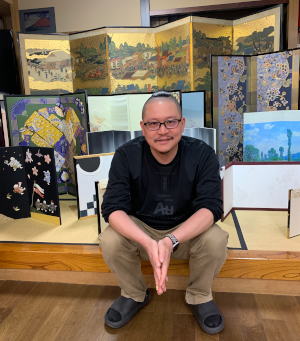
The Kataoka Byobu Store was founded in 1946. Mr. Koto Kataoka, whom I spoke with, became representative director and president of the company last year and is the third-generation owner of the store. Mr. Kataoka studied in the United States, so he is fluent in English. This English proficiency enables him to engage directly in overseas transactions and respond to foreign customers.
Mr. Koto Kataoka
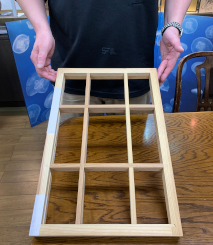
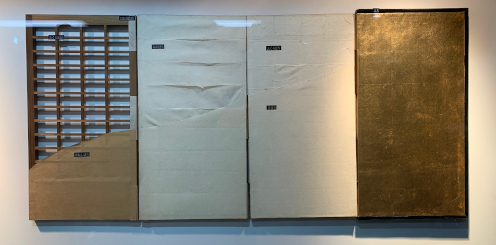
First of all, Mr. Kataoka gave me some basic knowledge about byobu. It is thought that byobu were transmitted to Japan from mainland China about 1,300 years ago. Their structure involves making panel-shaped frames by assembling wooden material in a lattice format and linking these panels horizontally with hinges. Then glue is applied over the wooden frames, and several layers of paper are stretched over them. Finally, foil or designs are applied to the surface.
A wooden frame forming the byobu base
The process of layering paper over the wooden frame
Washi hinges Mr. Kataoka thereupon showed me the major differences between Chinese byobu and Japanese byobu. First, Chinese byobu are heavy, because they mainly use wood from deciduous trees as material for the frames. And second, the hinges connecting the heavy byobu panels are often metal, so there are gaps between the panels.
A Chinese byobu with metal hinges
In contrast, Japanese byobu have no gaps and are amazingly lightweight. This is because they use light material, such as Japanese cedar, for the wooden frames, and the hinges, believe it or not, are made of washi (traditional Japanese paper). This washi hinge was an epoch-making Japanese invention that eliminated gaps between the panels and enabled the panels to be rotated 360 degrees. This is extremely convenient, because the byobu can be carried around and easily folded up for storage. What’s more, the pictures drawn on the surface do not seem to be impacted by the joints, so each one can be admired as a work of art in itself.
Washi hinges
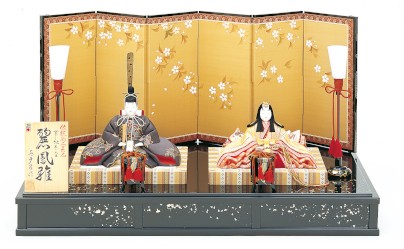
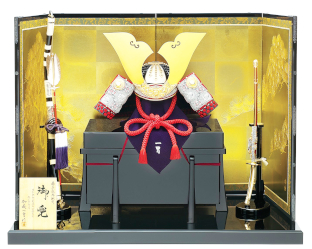
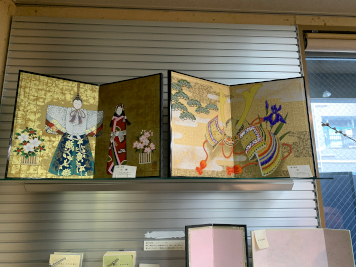
Byobu demand Nevertheless, my image of byobu was museum exhibitions, so I wondered what the main products of a byobu specialty store are. According to Mr. Kataoka, the greatest demand used to be, and still is, for festive byobu. In Japan there are two traditional festivals celebrating the growth of children, the Doll Festival (Momo no Sekku) for girls in March and Children’s Day (Tango no Sekku) for boys in May, and dolls are customarily displayed on both occasions (hina ningyo, or a set of dolls representing the emperor, empress, and attendants, in the former and gogatsu ningyo, or samurai dolls, in the latter). The festive byobu is a small golden screen always displayed behind these dolls.
Around the time when Mr. Kataoka’s grandfather founded the Kataoka Byobu Store, amid the postwar baby boom, the number of households displaying gorgeous dolls for the girls’ and boys’ festivals increased, and the demand for festive byobu grew rapidly. The Kataoka Byobu Store employed many artisans, and they were extremely busy making these festive byobu. The baby-boom period came to an end, however, and the birthrate started declining. Lifestyles changed as well, and the demand for festive byobu dropped. Therefore, the Kataoka Byobu Store renovated the first floor of its building into a showroom and devoted itself to taking orders from individual customers and producing custom-made byobu.
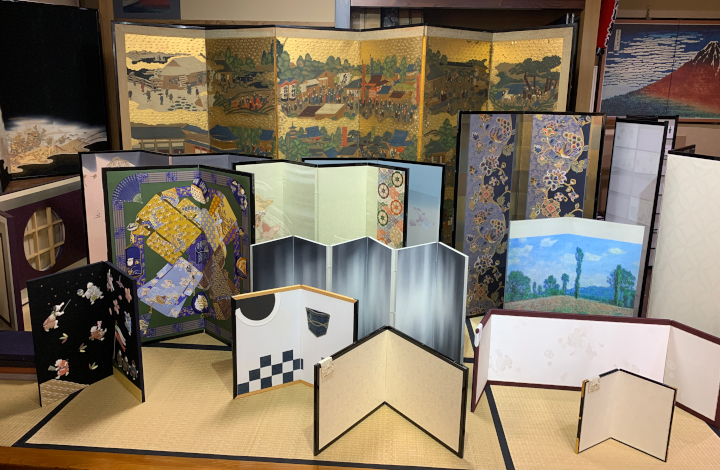
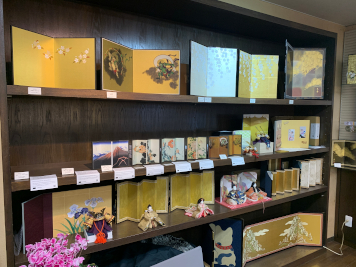
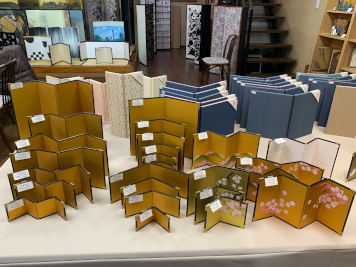
The Kataoka Byobu Store’s showroom
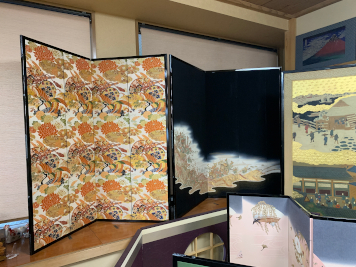
Popular byobu arrangements Among these custom-made byobu, which involve making the only folding screen of its kind in the world, especially popular are memorial screens, in which kimono and obi of sentimental value are made into byobu. In the past Japanese kimono were passed down from parent to child and, while undergoing alterations, they were worn preciously for generations. Nowadays, however, opportunities for wearing kimono have declined, and kimono that families previously cherished so much are now often sidelined at the back of the wardrobe. If such kimono are remade into byobu, these sentimental items can be adored every day as interior decorations. Moreover, the kimono and obi fabric goes well with washi, so apparently it is ideal material for being reborn as a folding screen.
A memorial byobu made from sentimental obi and kimono
A folding screen with mounted fabric designs
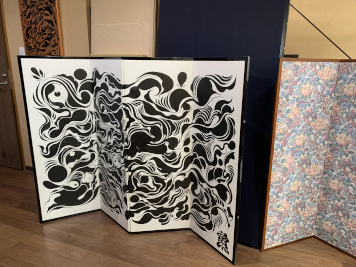
It is also possible to turn a favorite photo into a byobu. This process involves acquiring the data, printing it out using state-of-the-art printing technology, and making a byobu from this printed matter. As long as copyrights are properly processed, collaborations with various artists are possible too. So in addition to traditional designs, innovative byobu featuring anime and pop art can be made as well.
A pop-art byobu
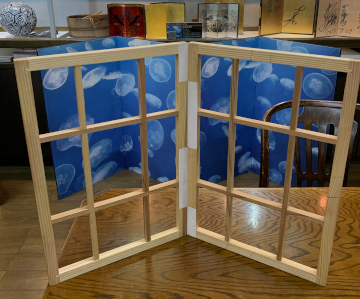
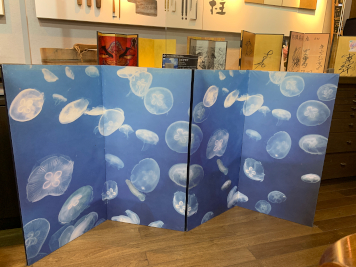
A byobu made from a photo of Jellyfish at the Sumida Aquarium
Manual design work Though the Kataoka Byobu Store utilizes state-of-the-art printing technology, the whole process of turning this printed matter into a byobu is done manually by artisans who, following traditional methods, use only paste and brush. In the task of pasting on paper, it is necessary to make delicate adjustments in accordance with the temperature and humidity on that day. This work depends entirely on the artisan’s experience. Multiple layers of paper are repeatedly pasted on the frame and dried, so the task takes many days. By turning it into a byobu, even original pop art is reborn as a handmade traditional craft.
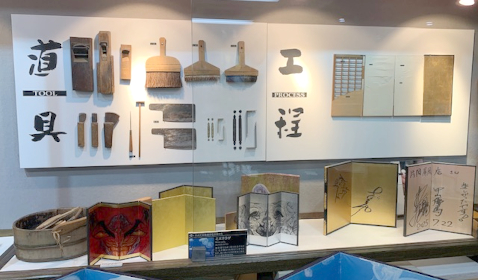
Tools used in making byobu
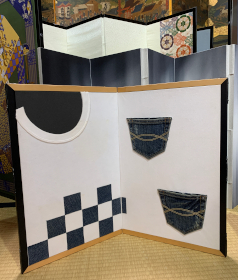
A byobu made from a T-shirt and jeans
Byobu practicality Originally byobu were furnishings incorporated into the daily lives of Japanese people, placed directly on the floor as room partitions or windbreakers. Furthermore, since things that people did not want to be seen could be placed behind a screen, a byobu was also used as a blind. In the Edo period (1603–1868) the common people lived in long rows of wooden terraced housing, called nagaya, and each family lived in one narrow room. So the byobu was an essential item. People used to roll up their bedding and hide it behind a byobu, eat in a space partitioned off by a byobu, and use a screen to keep out the draft. This practicality widens the range of options available to the owner of a byobu wondering where to place an artistic screen. For example, if someone wants to hide the entrance from the dining room to the kitchen (often directly linked in Japanese housing), they can place a screen with a likable picture there and use it as a nice blind. Unlike paintings hanging on a wall, a byobu is freestanding, so there is no need to screw holes in a wall. As another characteristic of the byobu, Mr. Kataoka noted that when not in use, it can be easily folded up and stored in a small space. It is thanks a lot to this characteristic, he pointed out, that byobu pictures drawn centuries ago are preserved in a relatively good condition. Since the surface picture can be folded inward, it is not impacted by direct sunlight or air, so the byobu is suited to long storage.
Background stage effect
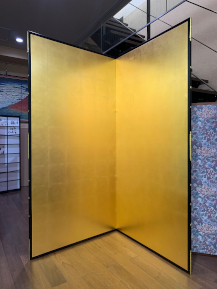
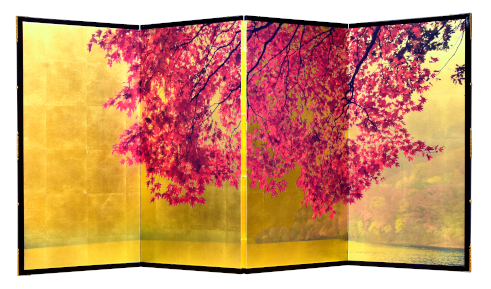
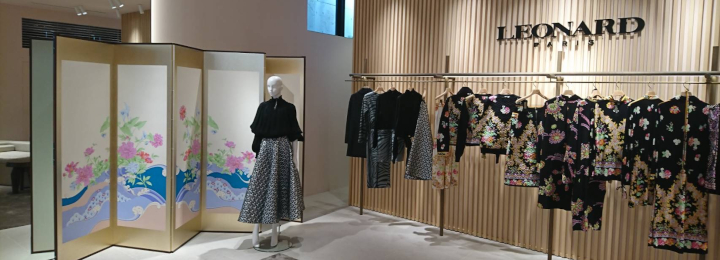
One more major role of byobu is their stage effect. Small golden byobu are placed in the background behind festive dolls because they create a gorgeous and celebratory atmosphere. Simply displaying a golden byobu in a wedding ceremony hall or congratulatory ceremony hall has the effect of lighting the place up, just like a spotlight, and drawing people’s attention. It really is an ideal prop for photo settings. Since a byobu is freestanding and easy to carry, a place’s atmosphere can be changed flexibly and promptly with it. Another use might be to place a byobu befitting a fashion brand image in the background of a shop display.
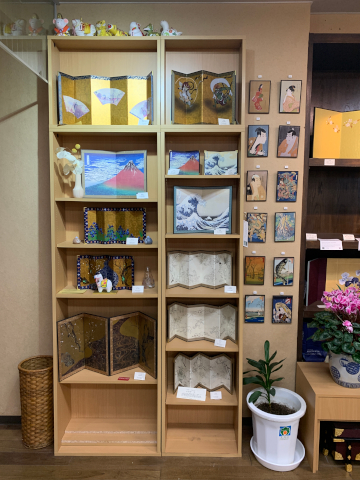
Hokusai byobu Since Sumida-ku in Tokyo, where the Kataoka Byobu Store is located, also has connections with the famous ukiyo-e painter Katsushika Hokusai (1760–1849), the store makes byobu featuring Hokusai’s ukiyo-e works, which are extremely popular both in Japan and overseas. These byobu are small, light, and foldable, so they are popular souvenirs among foreign tourists. They are also on sale at the nearby Tokyo Skytree gift shops.
Various Hokusai byobu line the shelves; some are so popular they are sold out.
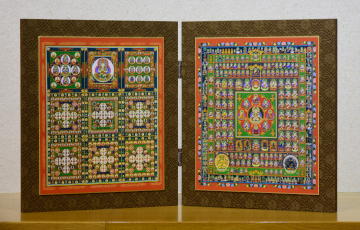
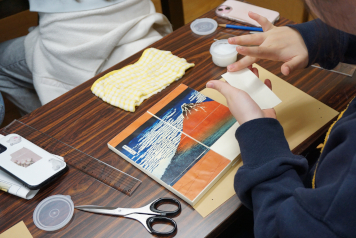
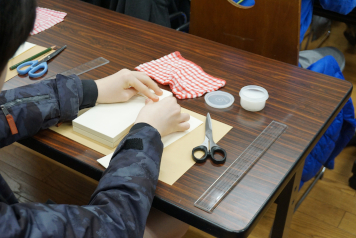
Workshops The Kataoka Byobu Store also holds workshops in which participants can experience making the popular Hokusai byobu as karakuri byobu (magic folding screens). These small magic folding screens are mysterious byobu in which different pictures or designs appear each time the screen is opened and closed. Four Hokusai byobu can be enjoyed in one magic byobu. These workshops are a good opportunity for participants, including students on school trips and foreign tourists, with the whole family taking part, to become more familiar with byobu and have great fun to boot.
New seasonal byobu The Kataoka Byobu Store continues to deliver seasonal byobu to doll wholesalers nationwide. But in addition to these conventional byobu, in consideration of the present housing situation in Japan, it also creates and sells compact, new styles of festive byobu.
A byobu integrating the hina ningyo dolls and a samurai helmet (You really don’t need to display actual dolls, do you?)
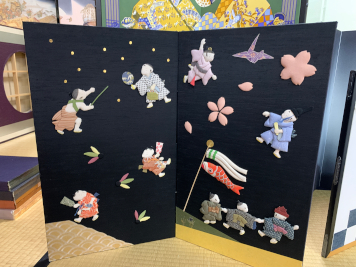
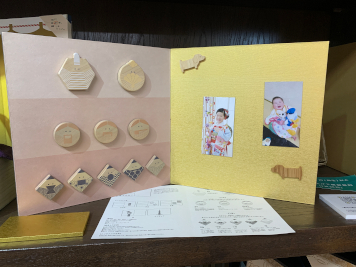
A byobu decorated with magnetic dolls (Magnetic dolls can be attached to a folding screen.)
The conventional hina ningyo dolls are expensive and easily broken, so young children are often not allowed to touch them. But with these new byobu, children themselves can learn by thinking about the position and role of each doll and attaching them accordingly. And when not in use, these byobu can be compactly folded up and stored. In addition, since the hinges can be rotated 360 degrees, the reverse side of the byobu can be used as another decorative panel. These byobu are a mine of ideas.
As I listened to Mr. Kataoka’s talk and gazed at the various large and small byobu on display in the showroom, my interest gradually grew, and I found myself dreaming more and more about what byobu I myself would like and where I would place them. Byobu combining both beauty and functionality are generating new usage. For example, they could be used as a stage prop in the background of a YouTube video, or maybe you could carry around a small byobu for use as a selfie background. Regarding the cost of custom-made byobu, Mr. Kataoka said that allowance is made for the customer’s budget. Anyway, first of all, why not go along and see the Kataoka Byobu Store’s showroom for yourself?
Cooperation Kataoka Byobu Store 1-31-6 Mukojima, Sumida-ku, Tokyo 131-0033 Tel.: 03-3622-4470 Website: http://www.byoubu.co.jp (Japanese site only)