The Nature and Blessings of Amami-Oshima Part 1: The “Light and Shade” of Amami as Seen by Isson Tanaka
The Nature and Blessings of Amami-Oshima
Part 1: The “Light and Shade” of Amami as Seen by Isson Tanaka
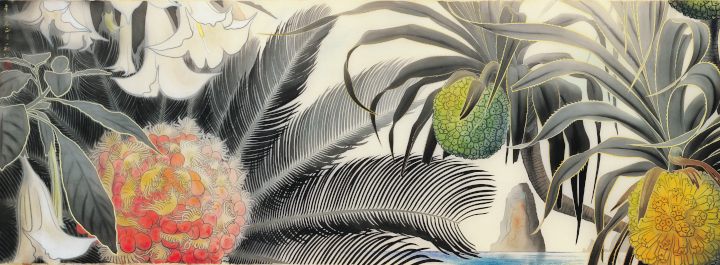
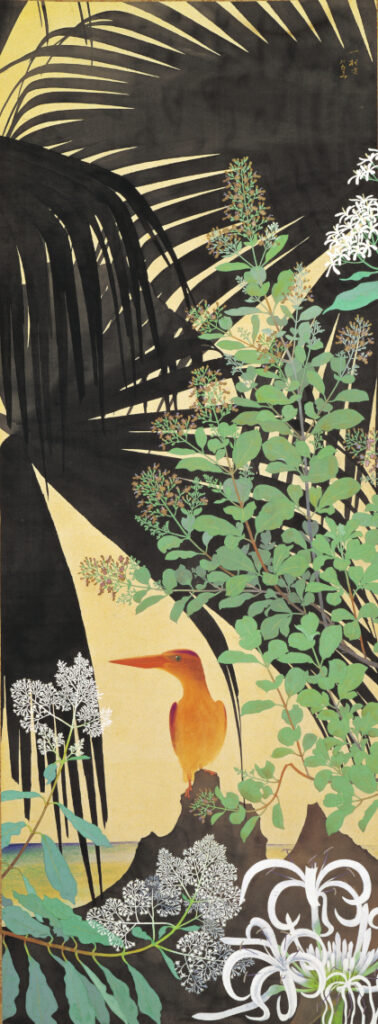
Sago Palm and Screw Pine by the Amami Ocean by Isson Tanaka; courtesy of the Tanaka Isson Art Museum © 2025 by Hiroshi Niiyama
Attracted by the paintings of Isson Tanaka, I visited the island of Amami-Oshima in the south of Japan. His paintings feature the exotic local flora and fauna, a bold composition, unique coloring, and, more than anything else, a strange “light and shade” perspective that really does make you feel as though you are looking out from inside a forest. I wanted to see the Amami that Isson saw with my own eyes.
The Tanaka Isson Art Museum
After landing at Amami Airport, I immediately visited the Tanaka Isson Art Museum in Kagoshima Prefecture Amami Park, which is only five minutes away from the airport by car. Naoya Uehara, the museum’s curator, showed me around.
In 1984 NHK, Japan’s public broadcaster, aired a program in its Sunday Art Museum series introducing the life and works of Isson. Titled “The Unorthodox Artist Isson Tanaka A Kuroshio Picture Book of Beauty and Cultural Climate,” the program received a huge response. That came seven years after Isson’s death. Subsequently in the 1980s and 1990s exhibitions on Isson, sponsored by NHK, were shown at department stores and other venues around Japan. Isson’s fandom grew throughout the country, and people visited Amami, making a kind of pilgrimage to the holy land. But there was no permanent facility displaying Isson’s works. Therefore, amid the growing interest in Isson, the Tanaka Isson Art Museum was opened in Amami Park in 2001.
When I visited in November 2025, the museum was holding a permanent fall exhibition in its four rooms. In the first room there was a display of paintings by Isson in his younger years, when he went by the name of Beison Tanaka. One can see from these early paintings why Tanaka was considered a child prodigy.
In the second and third rooms there was a collection of works that had been in the possession of Tosuke Okada, a doctor who was a supporter of Isson when the artist was living in Chiba Prefecture. So one can see works that Tanaka painted before he relocated to Amami-Oshima. Personally I liked his paintings of birds very much.
And then, at last, I entered the special exhibition room where, apart from a few, Isson’s works painted when he was living in Amami are shown. I felt that the atmosphere changed in some way. The plants, trees, birds, butterflies, fish, and unique scenery of Amami, which I was to see everywhere on the island during my visit, were on display here.
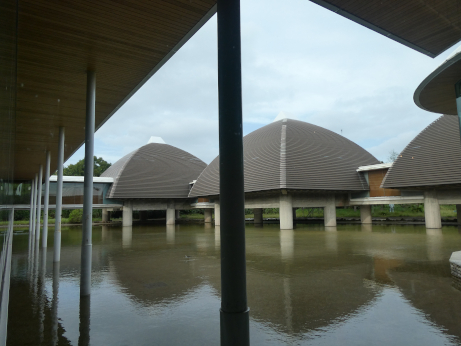
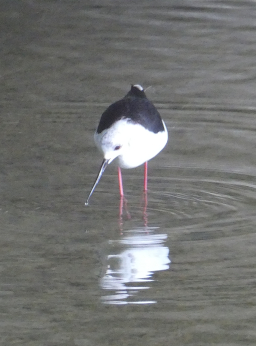
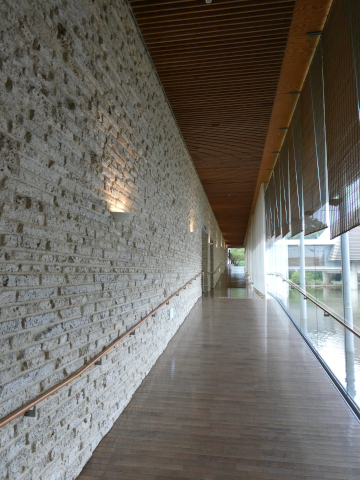
The design of the Tanaka Isson Art Museum is modeled on a traditional architectural style of Amami-Oshima called the takakura, which were storehouses built on stilts to prevent the entry of animals and other creatures. Below the museum’s takakura part there is a pond, and birds were pecking away at the small aquatic creatures in the water. The walls inside the quiet museum, made of white coral rock, exude warmth. As I walked around the museum, when I looked outside from the connecting corridors and elsewhere, the scenes that I saw were just like paintings by Isson.
I asked Mr. Uehara, the curator, about something that was puzzling me. “Why is it,” I said, “that many of Isson’s paintings have the perspective of looking out from within a forest?”
He replied, “I think Isson was an artist who painted the ordinary, natural scenery and flora and fauna of Amami and elevated it up to the level of art. He seems to have given a backlight effect to his paintings of everyday objects by using the contrast between light and shade.”
Isson is said to have loved birds. Since ruddy kingfishers like a warm climate, they had already flown away in the direction of the Philippines, so I was unable to see the real thing on this visit. But they often appear in a central role in Isson’s paintings. Sometime I really do want to see one of these distinctive birds with their large red bills.
Ruddy Kingfisher by the Sea in Early Summer by Isson Tanaka;
courtesy of the Tanaka Isson Art Museum © 2025 by Hiroshi Niiyama
Isson’s View of Amami
Using his paintings as a reference, I wanted to take a walk and see the scenes that Isson himself had viewed. But when I asked Mr. Uehara, he told me that it was not known when and where Isson had painted each work. More likely, Isson walked around the island drawing sketches of scenery, plants, and animals and then recomposed and combined them into paintings in his studio. So, similarly, I decided to take a walk to spot each component of Isson’s paintings.
After seeing his works, I took a stroll in the Isson Forest, a natural garden laid out around the museum. Many of the plants and trees appearing in Isson’s paintings have been planted on both sides of the pathway in this garden.
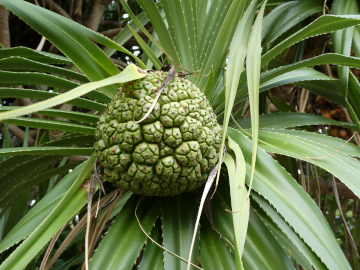
At this time of the year, the screw pine, which shines like a yellow sun in his paintings, appears like a green-colored soccer ball.
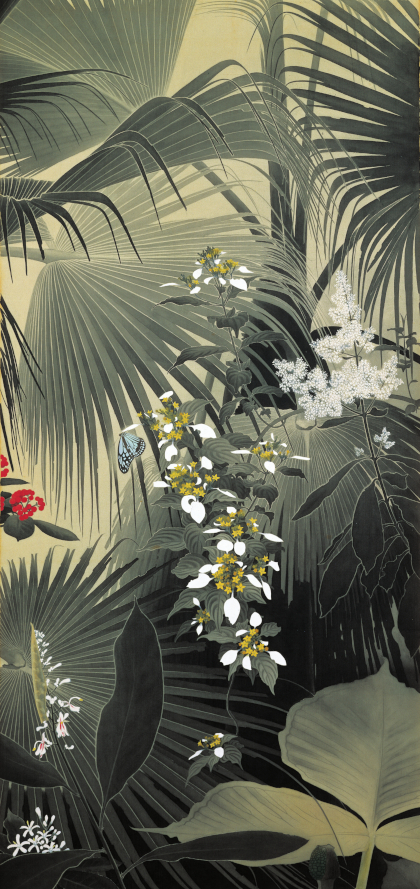
Chestnut Tiger Butterfly in Chinese Fan Palm Forest by Isson Tanaka;
courtesy of the Tanaka Isson Art Museum © 2025 by Hiroshi Niiyama
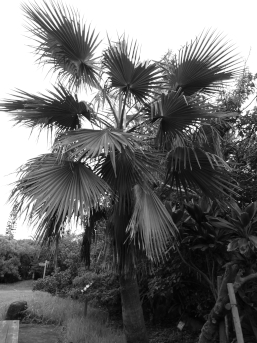
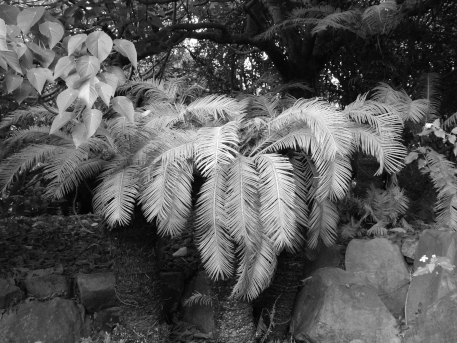
Then I take pictures of some Japanese sago palm and Chinese fan palm, which in Isson’s paintings project a strong presence in the shade. After a while, I came to think to myself that maybe they would look better in monochrome rather than color.
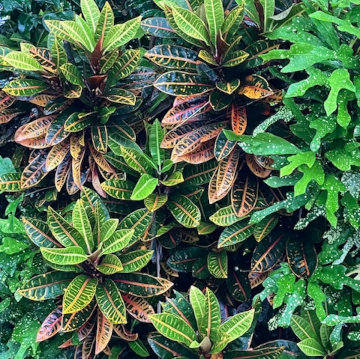
The next day I again took a walk on the island in search of the Amami that Isson had seen. Along the way, I stopped and, without thinking, took out my camera when I came across croton shrubs, which appear frequently in Isson’s works and in the language of flowers have the meaning of “bewitching.” These croton shrubs, which grow naturally alongside the national highway, are exotic plants whose green leaves have a yellow and red tint. Even in Isson’s paintings, they emit a rather amorous glow.
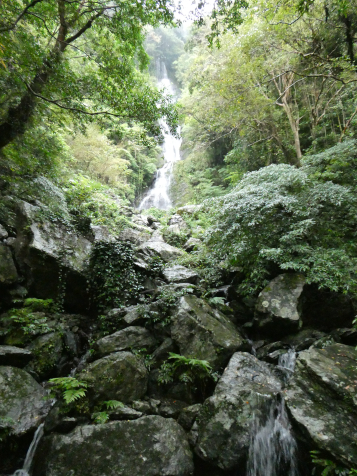
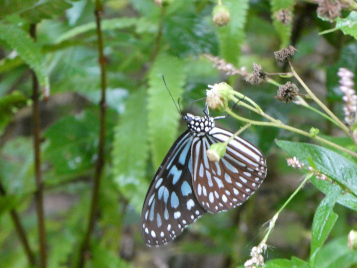
Butterflies appear a lot in Isson’s paintings too. They are the great orange-tip butterfly, which has white wings with orange tips, and the chestnut tiger butterfly, which has bluish white wings. These two species are perennial, so on this visit, despite the November rain, I was able to encounter both of them in Amami’s forests. In particular, along the mountain path leading to Funangyo Waterfall, a chestnut tiger butterfly came fluttering out from nowhere. Even in rain that made an umbrella essential, for a while I enjoyed the sight of its beautiful wings and elegant flight.
Funangyo Waterfall,
And A chestnut tiger butterfly seen on the mountain path near the fall
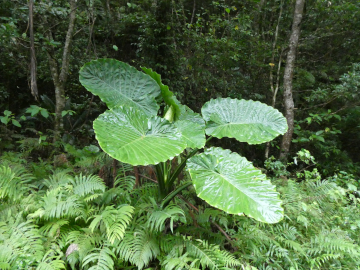
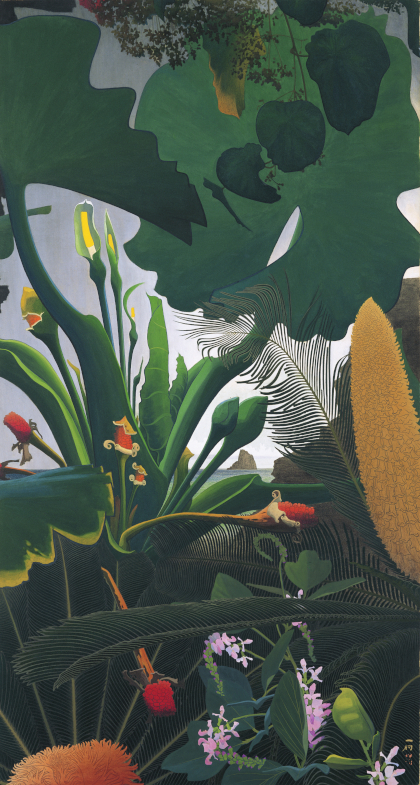
The centerpiece of Alocasia Odora and Sago Palm, one of Isson’s later works, is the Asian taro (or night-scented lily; Alocasia odora), which island people say even wild boars do not eat. Because it is poisonous, this plant, which belongs to the taro family, is, as the Japanese name kuwazuimo implies, inedible. The Asian taro’s characteristic is its large leaves that remind one of Totoro’s iconic leaf umbrella in the My Neighbor Totoro anime. In particular, I saw many of these plants, with their large leaves being pelted by the rain, along the mountain path on the way to Funangyo Waterfall.
Alocasia Odora and Sago Palm by Isson Tanaka; private collection
deposited with the Tanaka Isson Art Museum © 2025 by Hiroshi Niiyama
Whenever I see this Asian taro painting, I get a rather odd feeling. The colors are wonderful, of course, But more than that, the composition has a kind of stylish design to it that makes me think of modern art rather than Nihonga. It is very fresh and inspiring.
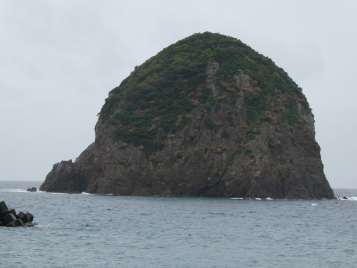
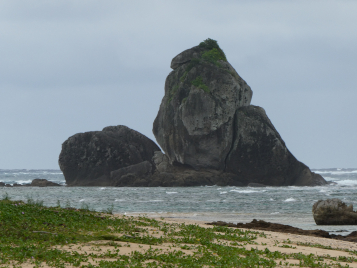
Another object in the middle of this work is the protruding rock painted small and far away in the distance. Called a tachigami in Japanese, these protruding rocks are a special feature of Amami’s landscape. The numerous protruding rocks, or small isles, in Amami-Oshima are said to be places where the gods land. Another tachigami appears in the screw-pine painting shown at the top of this article.
The protruding rocks, or tachigami, that I encountered
Who was Isson Tanaka?
Isson’s father was a sculptor, and from his younger years Isson was considered a child prodigy in the field of painting. At the age of 18 he entered the Nihonga department of Tokyo Fine Arts School (now Tokyo University of the Arts), but he dropped out two months later. Family illness is cited as a reason, but it is also suggested that Isson, who already was an established painter of the Nanga school, was discontented with university education. When his name spread as a Nanga painter, there were some people who supported him. But after Isson switched to the Nihonga school, apart from winning a prize once in the Seiryuten contest, he did not gain any praise from the central painting circles at all. Isson therefore set out on the road of self-study, moving to Amami, where he drew the subtropical nature there and broke new ground in the field of Nihonga. Isson died suddenly at the age of 69. His works were carefully kept by family members, supporters, friends, and other related people.
What was Isson’s state of mind as an artist? I think I found the answer to that question in the museum’s exhibition. In a panel titled “The Words of Isson” hung up by the paintings, there were the following words that he wrote in a letter to a friend: “However my final paintings might be appraised, whether humanistic or devilish, the right way or the wrong way, I am satisfied. I didn’t paint them to show to others but to assure my own conscience.”
Cooperation
Amami Park and the Tanaka Isson Art Museum
Address 1834 Setta, Kasari-cho, Amami City, Kagoshima Prefecture 894-0504
Tel.: 0997-55-2635
Website: https://amamipark.com/isson/
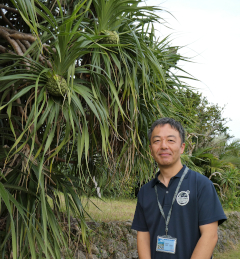
Contact: Art curator Naoya Uehara (photo with screw pine)
Amanico Guide Service
Operated by: Yuinchu Co., Ltd.
Address: 455-10 Nazeasani, Amami City, Kagoshima Prefecture 894-0043
Tel.: 0997-58-7879
Website: https://www.amami-occ.com/
Contact: Shinichiro Sato
*The president of Amanico Guide Service is Shun Shirahata. His father, who is in his seventies now, is of the generation that actually met Isson. In his childhood he lived nearby, and he remembers going into the house of this curious old man to play. His recollection shows us the unpretentious and friendly side of Isson.
- カテゴリー
- Art、Art、News、Tourist sites、Travel